4 Reasons Why Getlisted.org Local U Will Rock Your Web Marketing World

In honor of the Getlisted.org Local University seminar series coming to Syracuse next week presented by Syracuse.com and The Post-Standard (the 5th Local U that Advance and our local affiliated sites and newspapers have helped present), I thought I’d take a few minutes to outline the top four reasons why local businesses within a 250 mile radius have scored a winning Lotto ticket to have this event come to town.

Continue reading

How Do Consumers Find Sites? Natural Search Still Rules…

So what resources do consumers use to help them find websites? It’s a good question to answer as you’re thinking about how to prioritize your marketing efforts. I often talk about the importance of natural search visibility as a foundation to a 360 degree marketing program (surrounding your prospects and customers via many touch points- search, social, online and offline channels), and there’s a good reason for that. Forrester took a look at their 2011 consumer survey data on how US adults get to sites and found that by far the largest percentage—50%– find sites through organic search. As Forrester analyst Shar VanBoskirk reported: “natural search still beats the second-most common site-traffic driver — links from another site — by 19% (it also beats paid search by a whopping 42%- as navigation via paid links comes in at 8%).

Continue reading

Excerpts From ILM East: Paid vs Organic Search

One of the questions I often hear from both sales folks and businesses I talk to is-  what are the differences between paid and organic search and how are they most effectively used? There seems to be a whole lot of confusion out there on the whole PPC vs SEO question- even down to the basics of understanding how they operate (and I find a whole lot of people won’t even ask for fear the other kids in class will think they’re slow…). The reality is it can be very confusing, but to effectively harness one of the most powerful marketing channels today (search), you need to know the basics (I touched on this subject as well in an earlier blog post where I discuss the power of combining paid and organic search strategies together). In the video below from my talk at the ILM East conference in Boston this spring, you’ll see the basic analogy I like to use to help people to understand differences between the two.

Continue reading

The Future Of Media and Thinking Small

Media Industry Analyst Ken Doctor recently wrote a piece for Harvard’s Nieman Journalism Lab where he explored the future of newspaper revenues in local markets. One of Ken’s ideas is that it’s unlikely media companies will be able to simply replace the one or two big revenue sources they have relied on in the past- rather he predicts success will come from placing bets on a wider range of products and services.  It’s all of these “smaller golden eggs” collectively that can build a meaningful business for media companies. I was honored that Ken cited my most recent talk at the Interactive Marketing East Conference in Boston as part of his exploration of where new revenue streams will come from:

Continue reading

Businesses Used To Want “Advertising”, Now They Want Results

Businesses today are looking for results from digital advertising

Borrell Associates recently released their Annual Benchmarking Online Media report detailing shifts in local media spend.  Overall Borrell predicts that spending in local markets will jump 21% this year to nearly $20 billion, but one of the key trends they outline as part of this growth is the increase in “non-advertising” spend: comprising services like paid search, SEO, social media marketing and reputation management.  As Gordon Borrell recently commented:

“This transformation that we’ve begun to see, is that it is getting harder and harder to determine what’s advertising and what’s services…..Most forecasts call for a gradual slowdown of traditional advertising expenditures and growth in ‘non-advertising’ marketing and promotions spending. This change is based on the idea that advertisers actually want results more than they want advertising.”

Continue reading

Is The Change Hitting The Media Industry Today Really A “Revolution”?

The Digital Media Revolution

Recently, we had a very interesting debate among our team about using the word “revolution” to describe the rapid shifts happening in the media landscape today.  Is the digital disruption we’ve seen from the invention of the internet—and subsequent innovations like social media—more of an evolution?  Could the word “revolution” be a little dramatic….?  How big is this whole darn social thing anyway and how much is really going to be different?

To me it’s not just an academic question. If you work in the media or advertising business, how you view the scale of change occurring today impacts what you do about it.  If you think what you see happening around you is just a slight adjustment on the road of media history– one that will leave most of the existing infrastructure intact (although maybe slightly evolved), you’re not likely to do a whole heck of a lot about it in terms of your personal commitment to preparing and developing yourself for a new world.  Change is hard- particularly when the way you’ve always done things has worked for so long.

Continue reading

ILM East Conference View: Ad Spending Shifting To “Services” Like Content, SEO

John Denny speaking at ILM East Boston on SEO for CEO's

ILM East Boston: "SEO for CEO's"

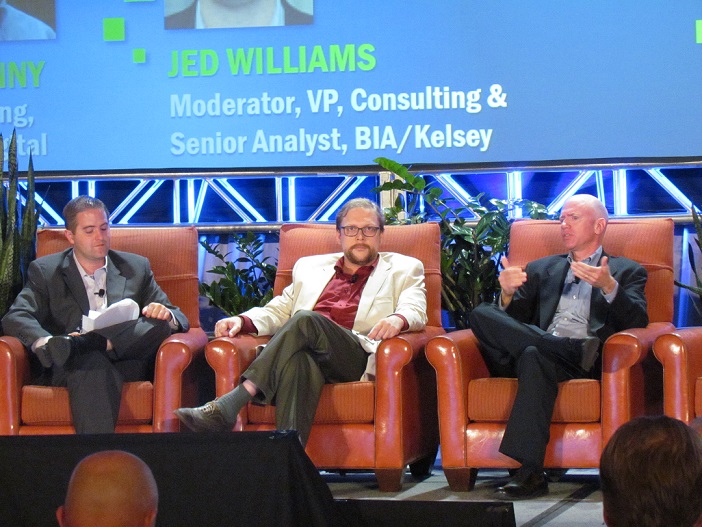
This week I had a great experience traveling to Boston to speak at the Kelsey Interactive Local Marketing East Conference. My overall talk was on the basics of SEO for CEO’s and building an in-house SEO department, but I also touched on the wider trends happening in search related marketing spend and how they impact local markets. Afterwards we had a panel discussion with two of the people I view as among the top experts in search (and local SEO): Will Scott and Andrew Shotland  (you can find a recap of the session on the Kelsey blog here).

One of the themes I touched on during my talk was the growing importance of “Services” in the world of marketing priorities for businesses. That money is now shifting from what has always been viewed as “Advertising” (whether traditional or digital media) to a whole host of growing priorities including Search Engine Optimization,  Social Media Optimization, blogs and Content Marketing.

Continue reading

The Big Marketing Shift: Understanding The New Content Marketing World

When I started my career in marketing and advertising in 1985, the world I operated in—and the rules for success– were clear.  The smartest brands spent loads of money on advertising, and then spent more loads on high-priced media to blast their message to consumers (those loads paid for our expensive agency TV Shoots and our nifty client dinners at Montrachet- the ones with the $250 bottles of wine).  The media companies—like TV Networks- functioned as the “connective tissue” between brand advertisers like Sony and Coke and the “target audience” (because what passed for “targeting” in those days was declaring that you wanted to reach the “18-34 demographic”).   If you wanted to tell a whole lot of people that Wendy’s had more beef and the competition only had a big fluffy bun (like my former boss Cliff Freeman did in his epic “Where’s the beef” TV spot), you needed ABC, NBC, CBS and the cable networks to get that message to your potential customers.  And all of it unfolded under the controlled, measured pace of our production timetables, planned campaign launches (because getting all of this done took at least 6 months) and the slow build of reach and frequency shown in our media flow charts.

And then came that darn invention of the Internet and the ensuing (and continuously unfolding) chaos created by the digital media revolution (putting a serious crimp in all those nice client dinners).   Continue reading

To The Marketers Confused By Twitter: Time To Get Over It

Forrester Research just came out with a new report this week on how marketers should be using Twitter right now to drive real business results. The report points out that marketers don’t get Twitter, and because they don’t get Twitter they are missing out on harnessing one of the world’s most powerful marketing channels.  As the report’s author Melissa Parrish describes- “because Twitter is so different, marketers struggle with it…..most marketers don’t really understand Twitter- neither it’s tricky challenges nor its unique possibilities”.

So here is a dose of reality for all of you confused marketers.  You need to get over it.  You need to decide tomorrow that you are going to master Twitter, and the only way you are going to do that is to personally join the Twitter community  and start living it.  And I don’t mean posting what you have for breakfast every 3 weeks.  I mean making it a part of your daily life, sharing useful content (otherwise known as Content Marketing in it’s most basic form), and engaging with other people on Twitter. I’ve written in past posts that any marketer – or anyone interested in finding customers today—needs to join the 21st century and get personally involved with social media NOW.  This is not a drill.  Things are not going back to the way they were in the safe, predictable mass media world we all knew. To remain relevant in this new world you are going to either need to speak its language or be marginalized.  Your choice.

Continue reading

Handling Negative Comments: A Quick Bootcamp For Business Owners

So we all know it’s going to happen.  Somewhere on your Facebook page, your Google Place page or somewhere on the web, the complainers are going to come out.  No matter how good your service is, no matter how great your product is, at some point someone is not going to be a happy camper.  So when that day comes, what should you do?  The question comes up all the time, and it seems like in this new world of social media, business owners just aren’t sure how to handle it.  I’ve written in the past about how to avoid the very popular “head in the sand” strategy and create a simple proactive reputation management plan.  Here I’ll get even more basic to give you a quick boot camp on some of the best
advice I’ve come across over the years on getting ahead of your cranky customers and turning what could be a bad situation into a positive one for your business.

Continue reading